miércoles, 19 de septiembre de 2012

07/09/2012

The 7th september we had to go into the Riet Vell lagoon and cut the upper parts of the Typha angustifolia. If it isn't cut, this plant's seeds fly to the nearby ecological rice fields and completely cover them.
I had been at the hide that morning seeing the usual herons and waders.

As we entered the lagoon, all the ducks, Flamingos and other birds took off so we worked alone, only finding sometimes a dead duck (Teals or Shelducks) and three nests which whe still don't know what they are.

In the afternoon I spent some time at the observatory (Ruffs, Little Bittern, Kingfisher, Glossy Ibis...) and aproximately at 6:30 we made a short trip to the Punta de la Banya with nice waders (Kentish Plover, Grey Plover, Sanderling...) and gulls/terns (Audouins Gull, Sandwich Tern...).

The pictures are from the sunset over the salinas, but if you look close over the horizon (right side of the pic) you'll see a large group of gulls.


martes, 18 de septiembre de 2012

06/09/2012

Wednesday was my second birding day, in which I saw many species.
In the reserve I got almost all of the herons (Night Heron, Little Bittern, Grey Heron, Squacco Heron, Little Egret, Great White Egret and a Purple Heron), some ducks as Teal, Mallard or Gadwall, and many waders: Little Stint, Wood and Common Sandpipers, Black-Tailed Godwit, Snipe...
Other important groups were gulls and terns (Audouins Gull, Common-, Gull Billed and Whiskered Terns) and passerines: with some migrating Pied Flycatchers, Sand Martins&Barn Swallows, Yellow Wagtail, Reed Warbler, Chiffchaff, and Zitting Cisticola.

 Juv. Common Tern
 Pied Flycatcher (In the middle)
 Little Egret
 Again the Juv. Flamingo
Sunset at Riet Vell

viernes, 14 de septiembre de 2012

04/09/2012

The first day after my arrival I woke up at 7:30 and was at the Riet Vell observatory at 8:00.
There were many Barn Swallows and Sand Martins. There were also a Squacco Heron, other Herons (Night, Grey, Cattle and Little Egret), a large flock of Black-Tailed Godwits with a Ruff, some Snipes and many Flamingos.

 Barn Swallow and Sand Martin
 Squacco Heron
 Juv. Flamingo
At 9:00 AM Ignasi Ripoll, the person who runs SEO Riet Vell brought us to a canal where we started extracting Apple Snails. An exotic species that causes important damages to the local fauna and the ricefields. While extracting it a large group of Glossy Ibises flew over us like some Bee Eaters (I couldn't see them), Gull-Billed and Whiskered Terns.
After having luch I took another look at the reserve, with more Flamingos, Wood, Common and Green Sandpipers, other waders, Kingfisher...
In the late afternoon we took the car and made a short trip to the Trabucador, with some Audouin Gulls, a Sandwich Tern and some Kentish Plovers.
 Ad. Flamingo
 Sunset over the lagoon
Drangonfly

jueves, 13 de septiembre de 2012

Volunteering at Riet Vell

Hello, I'm just back from 8 days of Birding and working at the Riet Vell reserve at the Delta de l'Ebre.
In the next days I'm posting a report for most of the days there.

viernes, 17 de agosto de 2012

Summer holiday in northern Spain 2012


Hello!
I’m just back from my holiday in the north of Spain after some time without going out birdwatching.
From the three weeks, I spent one with my dad in the Valle de Echo in the western Pyrenees and two more with both my parents in Asturias.
On the journey to the Pyrenees (14/07/12) we crossed the Lleida steppes (where I saw a White Stork from the car) and made a stop at the Mallos de Riglos. These are some very impressive walls in northern Aragón with birds like Red-Billed Chough, Griffon Vulture, Raven, Egyptian Vulture, Red Kite...).
Mallos de Riglos

We arrived at the Valle de Echo and made ourselves comfortable on the camping site some km far from Echo.
On Sunday 15th we made some “warm up” walks at the Selva d’Oza (a very interesting forest) and the Garganta del Infierno. At the Selva d’Oza (at a river of course) I saw my first Dipper of the year which flew past me like a bullet, in the river I also found Grey Wagtail and in the area I saw my first spanish Red-Backed Shrike!
 Castillo d'Acher
 Yellow-Billed Chough
Our first important excursion came on my birthday (16/07/12) with a walk to the Ibón de Estanés (1925m). It started at the end of the Echo Valley and got into a secondary valley called Aguastuertas. From Aguastuertas we continued to a mountain port from which you could see a really beautiful lake (Ibón de Estanés).
On the way up many Egyptian Vultures showed, some Black Redstarts and a Wheatear. We had been hearing Marmots all day and on the way down I finally saw one, I could even approach enough to take an acceptable picture.
 Valle de Aguas Tuertas
 Marmot
 Ibón d'Estanés
 Female Wheatear
The next day we decided to climb up to the Ibón d’Acherito (another mountain lake). This walk was shorter than Estanés but it had a bigger difficulty. In Acherito we didn’t see anything special, the usual mountain species (Black-Redstart, Choughs, Raven, Yellowhammer, Crag Martin).
 Pyrenean Brook Salamander???
 Ibón d'Acherito
The following days were really hot, so we didn’t climb more, but I still saw some interesting species; at the village of Echo a Booted Eagle flew over us, we heard a Black Woodpecker from the campingsite and I observed a Crested Tit in a Pine Tree.
After almost a week at the Echo Valley we sterted our journey to the north. We had to stop in Bilbao cause my mother was coming by plane, but we had an entire day until that happened. We decided to sleep in Pamplona and to visit the canyons of Lumbier and Arbayún.
We started with the Foz De Arbayún, the most impressive one. From a plattform, we could easily watch Griffon Vultures, both Kites, Egyptian Vulture and Booted and Snake Eagles. There were also many Alpine Swifts and Crag Martins.
 Foz de Arbayún
 Griffon Vultures
 Griffon Vulture
 Egyptian Vulture
 Short-Toed Snake Eagle
Black Kite
The Foz de Lumbier also produced very nice observations. The Vultures flew really close to people and many other raptors were present. Appart from the usual Kites and Vultures a Hobby showed quickly and another unidentified falcon (prob. a Hobby) flew past.
On the way back from Lumbier, across a bush landscape I saw a semi-lifer (already observed it but hadn’t identified it), a female Cirl Bunting from which I show you some photos.
 Raven
 Griffon Vultures

 Cirl Bunting
We picked up my mum and headed west to the western coast of Asturias (Luarca), remaining there for five days. We spent a couple of days there visiting beaches mainly, but also did a visit to Cape Busto, with some observations of Shags, Kestrels and Gulls.
Kestrel
After the west coast we went back to the eastern coast (Ribadesella), also visiting beaches. The best observation from these days was a group of 20 migrating Curlews from a cape in a day where we also saw a quite big (40-50cm), unidentified snake.
The last part of our holidays were spent in the Picos de Europa, where I saw some alpine species that I hadn’t seen in the Pyrenees.
On the first day there, we climbed up from Poncebos to Bulnes (one of the last villages in Spain that hasn’t got a road). On this hike, I could see my first Citril Finch of the year and a very impressive scene: a Golden Eagle attacked by a group of aprox. 50 Alpine Choughs.
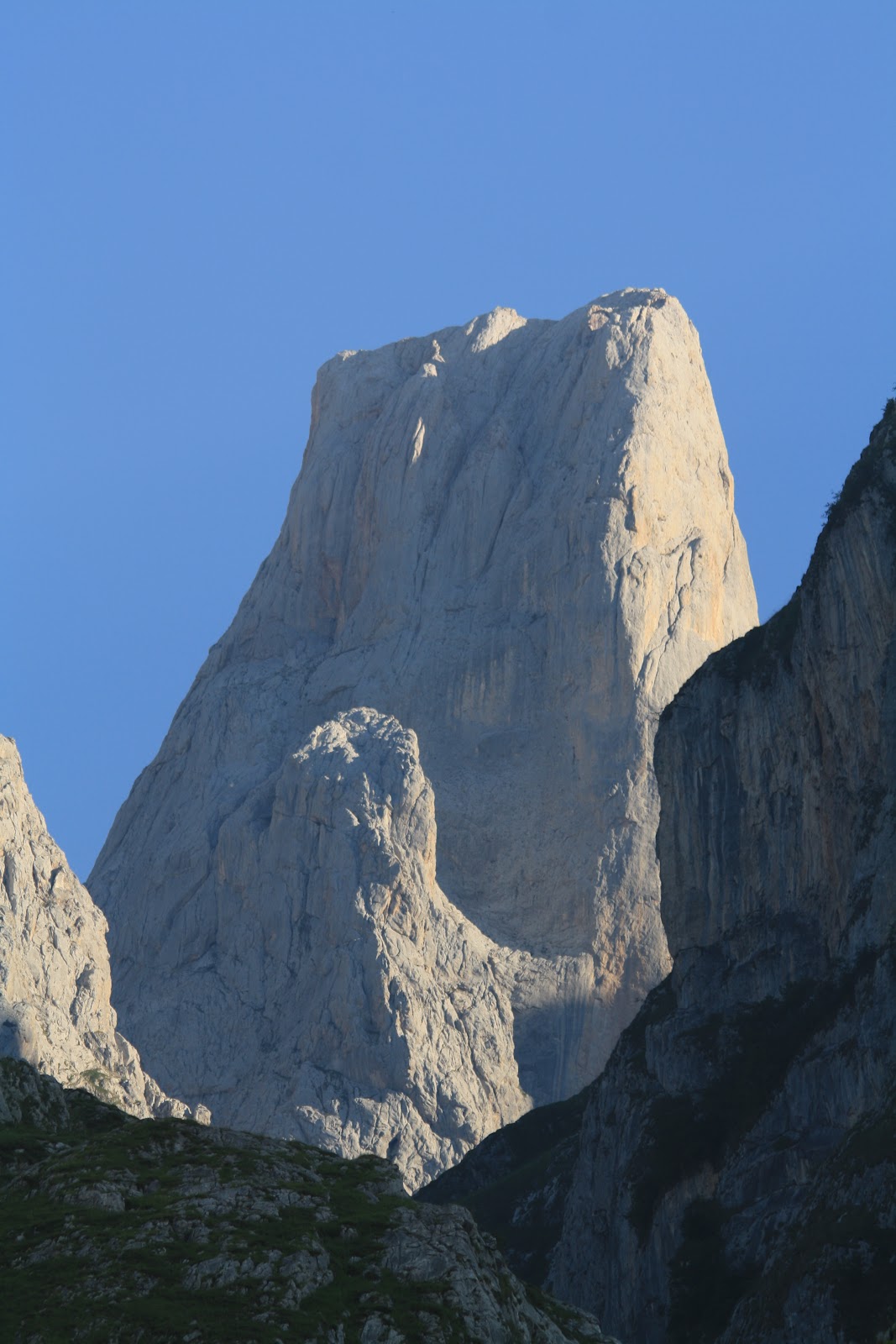
 Picu Uriellu (Naranjo de Bulnes) 2519m
We didn’t like the hostel in Bulnes so we decided to get to Poncebos the next day and find a nice campingsite. We found one in Arenas de Cabrales and decided to do other hikes in the area the following days. At the camping site I had one of the best birds of the trip, a Nuthatch, my first for Spain.
Finally, on the 2nd and 3rd August we went to a place that I really enjoyed, it was called Vega de Sotres, and it had an important population of the best bird from the trip, Rock Thrush. Vega de Sotres is a little village which is only inhabited by a couple of cows and some Chicken. It’s walls and roofs are an ideal place to see Rock Thrush, Wheatears, Stonechats and even Red-Billed Chough. Alpine Choughs were also present but didn’t get too close to the village. I saw again the scene with the Golden Eagle and the Choughs.
Rock Thrush
Moon
Rock Thrush
Red-Billed Chough
 Linnet
I hope you enjoyed my report, now I’m spending two weeks in Germany with my grandma and then I’ll be one week at the Delta de l’Ebre doing some volunteer work.

viernes, 13 de julio de 2012

Summer holidays

I have been pretty busy these days and haven't had time to go birding.

Tomorrow I'm leaving for three weeks (one in the Pyrenees and two more in northern Spain, probably Asturias).

I hope to see some nice alpine species in the Pyrenees and Picos de Europa. I hope to see Lammergeier, Alpine Accentor, Alpine Cough, Black Woodpecker, Rock Thrush, Warblers...

I'll write my trip report as soon as I can when I'm back.

See you in three weeks!

viernes, 1 de junio de 2012

Delta de l'Ebre 27/05/2012

Hello, it's been a long time!

After over two months without birding (due to moving appartment) I finally could go out again.
My parents agreed to take me to the Delta del Ebro, so we took the car and arrived there at 11 o'clock.
While driving to the Encanyissada, we saw the first Gull Billed and Whiskered Terns and a Purple Heron.
Once at the Encanyissada, at the Pont de Través, we climbed up the observation tower and started looking.
There was a large Flamingo group, some Great Reed Warblers singing and a good number of ducks (mostly Mallards and Red Crested Pochards, but we also saw some Shelducks). There were also present Little and Great Crested Grebe, Swallows and more terns (this time including Little and Common).
 A group of Flamingos just about to land
 Night Heron
 Great Crested Grebe
The best bird at the Pont de Través was an adult Night Heron, which flew over the observation tower.
 We moved on to the Salines de Sant Antoni after a short lunch at Poblenou, while driving past the old salt pans I saw Green and Redshank, Common Sandpiper and a single Kentish Plover.
 The Kentish Plover at Sant Antoni
We tried to look for waders at the Trabucador, but it was full of people kitesurfing and sunbathing so we didn't continue and went to La Tancada.
At La Tancada, as usual, large Flamingo groups were present, many Barn Swallows and some ducks and Coots.
Then, the best species of the day flew past the observatory, a Caspian Tern. It's the fourth time I see them but its still a bird I love, I managed to get a few blurred pictures.
 Caspian Tern at La Tancada
Our next stop was Riet Vell where we met Ignasi Ripoll, and discussed about dates to go doing some volunteer job there this summer (we'll see what happens). At Riet Vell there was a huge Common Tern activity, many of them copulating and acting quite nervous.
As usual, there were many Purple Swamphens, and I also saw two Avocets and two Litlle Bitterns. Another two interesting species were a Barn Swallow who was sitting on a reed and I got some good pictures as same as a Great Reed Warbler.
 This Swallow was litterally posing for me
 Two Common Terns having some good time ;)
 Great Reed Warbler
After Riet Vell we had only one more stop at the Badia del Fangar to see some waders (which finally didn't show up). On the rice fields there were many Glossy Ibises and at the bay we met Tony Martin, who showed us a pair of Collared Pratincoles.
 A Glossy Ibis on a rice field in the northern part of the Delta
 Between the reeds you can see the Collared Praticole
All in all, it was 51 species, not many for the Delta del Ebro, but still some nice observations. And fianally out birding again!!!